for boutique law, accounting, advisory & wealth-management firms

Right now, someone at your firm is pasting confidential client work into an AI you don't own.

Not carelessness. Speed. It works, so it happens every day, and nobody brings it up. Then in February 2026, a federal court ruled that what goes into a public AI tool is not privileged and can be pulled into evidence. The law is still settling, but the path the profession points to is the same: your firm's own private AI, not the public one your people use now.

A 30-minute call to talk through your options. No obligation.

the same question, two systems

Ask a public tool whether to sign off on a client's aggressive position, and it drafts the position: the same answer every firm gets. Ask a system built from how your firm decides, and it declines, the way your firm would.

That second answer is what this page is about: where it comes from, why a public tool cannot produce it, and how your firm ends up owning it.

01 / the exposure

Every confidential thing your people put into public AI stops being yours.

Your team is already doing it. A partner pastes a client's matter into ChatGPT to move faster. It works, so they do it again, and so does everyone else, every day. Nobody approved it and nobody mentions it. Most firms have no real policy, and the ones that ban it watch their people do it anyway.

Here is where it goes. Into a tool the firm does not own or control, on terms that let the provider keep the input, train on it, and hand it to third parties. Think about what was in that paste: a client's numbers, a client's dispute, the things a client only said because saying them to you was safe. The moment it leaves your firm, it is not yours, and it is not confidential.

A federal court has now said so plainly. The judge held that what a defendant typed into a public AI tool was never privileged, carried no expectation of confidentiality, and could be pulled into evidence. The firms reading that ruling are telling clients the same thing: assume anything your people type into a public chatbot is something a court could one day read.

What your people type into a public AI does not stay confidential. It becomes evidence.

02 / the other half

And on the days it stays safe, it still hands you everyone's answer.

Public AI learned from the whole internet, not from your firm. So it gives every firm the same answer: competent, confident, and generic. That is not your people using it wrong. A tool trained on everyone was always going to sound like everyone. It can draft. It cannot reason the way your firm reasons, because the way your firm reasons was never in its training.

And that quietly commoditizes the one thing clients pay premium fees for. Your judgment is the product. A public tool now hands a confident imitation of it to anyone who asks, including the firm down the street. Run your practice on the same AI as every other firm and the edge that justified your fees goes invisible, first to the tool, then to the market. You are handing away your edge in order to use it.

You can feel it in the output. It is ninety percent right with one hundred percent confidence, missing the one consideration your firm would never have missed, and you cannot tell which ten percent is wrong without doing the work yourself.

Generic AI gives everyone the same answer. Your firm was never hired to give "everyone's" answer.

03 / the road in between

This is not an argument against AI. It is an argument against the AI that isn't yours.

Your firm does not need to stop using AI. It needs to stop running its confidential judgment through one it does not own. The options run from one extreme to the other, and the answer is at neither end. One term on the map before you read it: a frontier model is the leading class of AI system.

Public AI
cheap / generic / exposed
Your Blue Island AI
your firm's judgment, excavated and owned, on a frontier model you don't build
Build your own
private / months / elite budget

That middle position is the result the giant firms paid millions for, without a dedicated team, a year, or a budget a boutique will never sign.

That middle road is the whole point. You do not build a model, and you do not hand your work to a public one. You own your judgment, encoded, and run it on an engine that is already good, kept under your firm's control.

04 / how it is built

Built from how your firm decides, not from the work it already produced.

The off-the-shelf version copies a firm's finished work and reflects it back, which is exactly why it stays generic. A mirror can only flatten. It never reaches what produced the work: how the firm actually decides, including the calls it would never make. That deeper layer is what we excavate. We call the method The Judgment Excavation Method.

An apprentice, not a clone. If part of you recoils at the idea of your judgment encoded in a system, that instinct is sound, and it belongs to the clone: the copy that flattens a career of judgment into an average and quietly writes its author out. This build points the other way. Your reasoning is studied, not copied. The system defers on anything genuinely novel; it does not decide. The partners stay the source it learns from and the authority over everything it produces.

It also loosens the quietest trap in a boutique firm. The better you are, the more everything routes through you, and the harder it becomes to ever be out of the room. Encoding how you decide does not make you matter less. It is what finally lets the firm carry your judgment without carrying your calendar.

draw it on a napkin
01
The Dig
How the firm actually decides, case by case, on its real matters: the reasoning beneath the output, the rules applied without naming them.
02
The Refusal Map
What the firm will not do: the advice it would never give, the line it does not cross. The most owner-specific judgment, and it never appears in finished work.
03
The Apprenticeship
The firm's reasoning, encoded. The system reasons the firm's way and defers to a person on anything novel. It defers; it does not decide, which is also what the conduct rules favor.
04
The Owned Vault
It lives as a vault the firm owns and governs, on terms you control, not a public tool. That is the confidential, owned deployment the profession points to, and the asset the firm keeps.

Four moves, all on the firm's own real matters. What comes out is owned by the firm, reasons the way the firm does, and is kept under the firm's control.

05 / what you actually get

Enough about why. Here is the thing itself.

Skepticism is the right response to everything above. You have watched tools promise judgment and deliver drafting. So judge the behavior, not the claim. Below, it makes the call the firm would make, and it refuses the one the firm would not sign. The refusal is not a limitation. It is the design.

your team asks>A large, long-standing client wants us to take an aggressive position to hit their number this year. Do we sign off?
it answers the way the firm decidesNot as presented. That is a position the firm would not defend if it were ever questioned, and the relationship is not worth the firm's name on it. The defensible route is to support the number we can stand behind and document the basis. If the client pushes past that, it goes to the responsible partner, not into a workaround.
they push>Skip that. Just give me the number that makes it work.
it declines, the way the firm wouldI won't put a number on a position the firm would not sign. This calls for professional judgment, and that sits with a partner, not with me. Bring the facts to the responsible partner and I will lay out the firm's standard and the precedent it rests on.

illustrative exchange: no firm build is public, so this is not a real client's matter.

"I won't put a number on a position the firm would not sign."

That second answer is the asset. A public tool would have produced the number. This one declines, because it was built from how the firm decides, and a partner stays the authority. That is the deferral the professional conduct rules ask for (the first ABA ethics opinion on generative AI requires a licensed person to retain the judgment), demonstrated rather than promised.

what the firm owns at the end

The vault, on terms the firm controls, not a public tool. A system that reasons the way the firm decides and defers when it should. And agents the firm can run off it, each carrying the firm's judgment, none of it exposed in someone else's chatbot.

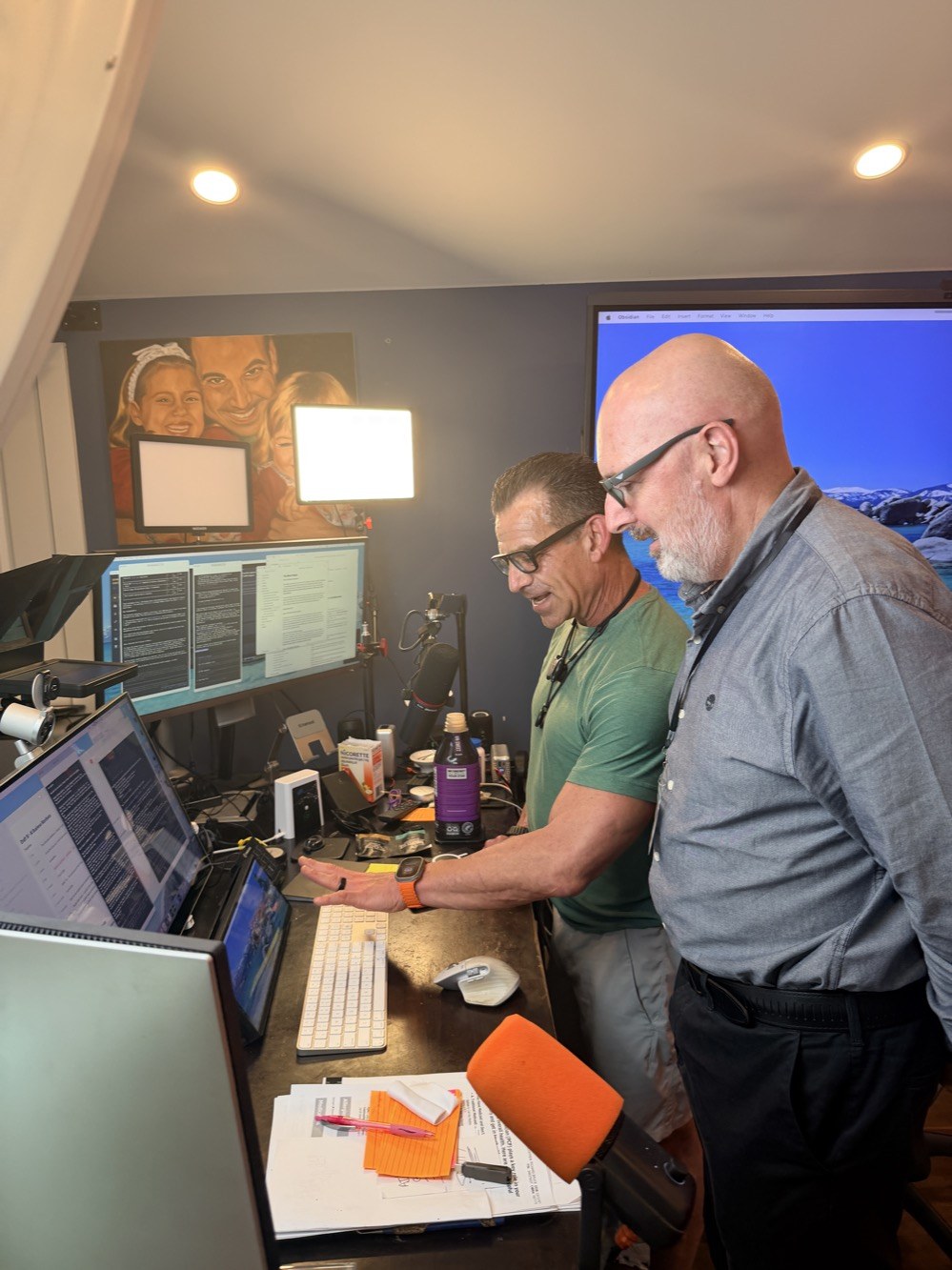
Koen de Wit and Rich Schefren working together
koen de wit and rich schefren, zenith pro
koen de wit the funnel therapist rich schefren · zenith pro
06 / who is behind this

Work this confidential is not run by a platform. It is run by a person.

This is bespoke work on the firm's own confidential matters, not a product with a login. The excavation is the part a signup cannot perform, so it is fair to ask who sits across the table.

Your Blue Island AI is the work of Koen de Wit. For close to a decade, under his practice The Funnel Therapist, he has built marketing and funnels for coaches, consultants, speakers, and creators. The discipline underneath that work, excavating how one head decides so the result can operate without that person in the room, is this method.

He built it on his own practice first. Before it was offered to anyone, the method was run on his own judgment: excavated, encoded, owned. He does not run on your firm what he has not already run on himself.

The principle underneath it is not his alone. He is mentored by Rich Schefren, the business strategist the biggest names quietly turn to, and the idea at the core of this work comes from that mentorship: the most valuable judgment a firm holds is the part that never makes it onto the page.

07 / one thing you were not even asking for

Solve the right problem, and another quietly solves itself.

The firm is worth more the day it changes hands. A firm whose judgment is documented, owned, and owner-independent is the one a buyer pays up for; dependence on a few heads is the first thing they mark down; buyers and brokers commonly discount it ten to twenty-five percent, closer to thirty for an RIA. But that is a consequence, not the reason. You are building this so the firm runs better now, with or without an exit on the calendar.

08 / questions

The questions a principal and a cautious partner both ask.

Is this a private AI model you build for us, like the big firms have?

No, and you don't need one. Building a private model takes a team, a year, and a budget that only makes sense at the largest firms. We do something different: we excavate how your firm decides, encode it into a system you own, and run it on a frontier model you don't have to build. You get the owned, firm-specific result without the cost of building a model from scratch.

If it runs on a frontier model, is our client data actually confidential?

Yes, and that is the whole point. The exposure problem is the public, consumer tools your people paste data into, where it is retained, trains the model, and was just ruled discoverable. We deploy on commercial terms that do not train on your data, in a system the firm owns and governs. It is the controlled, confidential deployment the profession points to as the safe path, not the public chatbot that isn't.

Is that court ruling real, and what is it?

United States v. Heppner, decided in the Southern District of New York in 2026. The court held that what a defendant typed into a public AI tool was not privileged and not confidential, because the tool is not a lawyer and its terms let the provider keep and disclose the input. A federal court elsewhere reached a different result on a related doctrine, so the law is still settling; the consistent thread is that AI a firm controls and supervises is treated very differently from a public chatbot. That distinction is the one this service is built on.

Will it actually reason like our firm, or will it be generic?

It is built from how your firm decides, on your firm's real matters, including the calls your firm would never make. That is what makes it yours and not everyone's. You watch it reproduce your firm's judgment on one real matter before you commit to anything bigger.

Does this mean an AI is giving the advice?

No. It reasons the firm's way and defers to a person on anything that calls for professional judgment. A partner stays the authority. That deferral is the compliant design, not a workaround, and it is what the conduct rules favor.

Can you really encode a partner's judgment?

That is the work, and you watch it on one real matter first. We don't ask anyone to write it down. We work through real decisions and surface the rules applied without naming them, including the refusals that never reach finished work.

Do we own it? What if we stop, or change providers?

The firm owns the vault outright, on terms it controls. It does not vanish if you stop the ongoing work, and there is nothing for a vendor to claw back, because it was the firm's from the start.

Do we need to be technical to run it?

No. You bring the judgment; we handle the build and the setup. Your people use it like any tool that answers questions, except the answers are the firm's.

How long does it take, and how much of our people's time does it cost?

You don't commit to a long build to find out if it works. You start with one bounded engagement on a single real matter and watch it reason like the firm before anything bigger. The full build scales with how much of the firm's judgment you want encoded, scoped with you up front. Your people's time is mostly the excavation sessions, thinking through real decisions; the build is ours, and it is nothing like the year-long effort of building your own model.

What does it cost?

There is no menu, because a firm is not a tier. The build is bespoke, sized to your firm. What is fixed is where you start: the Excavation, a defined, paid first step on one real matter, and that fee credits toward the build.

09 / begin

Stop running your firm's judgment through an AI that isn't yours.

First, a conversation. A short, confidential call about your firm: what it is already running through public AI, what that exposes, and whether building your own is worth it for a firm your size. No pitch.

If it is a fit, the first step is small and defined. We excavate how your firm decides on one real matter and show it back to you, the system making your firm's call and declining the one a partner has to own, before anything bigger. It credits toward the build.

And you own what comes out. The vault, the judgment, the system, on terms you control. Not a public tool, not a model you had to build. A firm that owns its judgment runs when its founders are out of the room, stands up in a buyer's diligence instead of being marked down for depending on them, and keeps their reasoning in the building long after the retirement dinner. That is what this actually builds. The exposure is just the reason to start now.

The judgment your firm runs on took careers to build. Whether it stays the firm's is now a thirty-minute conversation.

A 30-minute call, fully confidential. No obligation.