
Right now it does. Every answer that matters still has to come out of your mouth, live. We build you a custom AI system from how you decide, not what you say, so your judgment shows up in the rooms you are not in. And it does not guess in your name.
A 30-minute call to talk through your options. No obligation.
Rewrite the headline, add testimonials, tighten the call to action. Plausible. Generic. Not you.
Don't touch the copy yet. Most funnels aren't broken, they're misaligned. Diagnose first.
You remember the moment. You fed it everything, your articles, your talks, years of work, and asked for your thinking back. What came back was fluent, confident, and hollow. You knew it in seconds. The frameworks survived. You did not.
So you did what serious people do: you blamed your end of it. Sharper prompts. More context. More of you. And when it still came back hollow, you filed the quiet verdict every expert files: maybe what I do can't actually be captured. Maybe the problem is me.
It is not. It never was. Every one of those attempts was built the same way: fed what you had already produced and made to reflect the surface back. You sensed they were hollow from the start. You were right.
A mirror can only return what is placed in front of it.
So try this. Go back through everything you have ever published. It's full of the decisions you made, and almost none you refused: the advice you would never give, the client you turned away, the shortcut you will not take even when it works.
You never published your refusals, the things you would never do. So no AI built from your work could ever learn them.
a mirror fails in three exact ways
Read that slowly, because it lifts a verdict you may have quietly passed on yourself.
You did not fail at building an AI of yourself. You were handed a mirror, and a mirror was never going to hold what you never published.
The bottleneck is never the AI. It is that no one has ever excavated how you decide.
Naming it is the first honest thing anyone has told you about why it failed.
The first failure is fidelity: a mirror never truly holds your judgment. The second has nothing to do with how good it is. It all lives on someone else's machine, under terms you do not set.
Every refinement, every correction, every hour you spend making it less wrong, the tool keeps. Not you. You are not building an asset. You are improving a product you will never own.
And the rental has a kill switch. Stop paying and it does not slow down or degrade. It is gone, and everything you have taught it goes with it, locked behind a door you do not hold the key to.
You are not building an asset. You are renting your own expertise back.
This is the quiet cost of pouring your life's work into a tool you do not control. It does not compound for you, it cannot leave with you, and it is not yours to keep, to sell, or to build on.
Your judgment is the most valuable thing you own. It should not live as a lease, with your expertise as the deposit. It belongs on your own machine, owned outright.
A mirror is hollow, and it is never yours. So the thing you actually need is the opposite on both counts. Three things have to be true at once, and no tool you have tried even attempted all three.
That is not a better mirror. It is a different kind of thing entirely. A mirror reflects what you said. What you actually need is something that learned how you decide, and applies it in the rooms you are not in.
An apprentice, not a clone. Everything you are afraid this will do, flatten you, wear your name badly, prove you replaceable in your own business, is what clones do, because copying the surface is all a clone can do. An apprentice works the other way. It learns the judgment beneath the work, case after case, under you, and defers to you on anything genuinely novel. You are not being copied. You are being studied, the way masters have always been studied. The master is you.
There is only one way to build that. Not a signup, which can only start from what you upload, but a person, digging out how you actually think on your own real decisions. That is the work. Here is how it is done.
We call it The Judgment Excavation Method. Four moves, performed by a person, on your own real decisions.
The field could not reproduce this even if it wished to. A self-serve signup is the absence of The Dig.
A hosted product cannot offer The Owned Vault, because its revenue depends on you never owning the asset. Each competitor would have to abandon the model that funds them to perform this method.
That is not a clever advantage. It is a structural one.
Every tool you have tried had the same tell: push it one question past what you gave it, and it bluffs. So do not take any of this on argument. This is the system Koen de Wit, the builder behind Your Blue Island AI, built for his own work, running on his own judgment. Watch it make his call. Then watch it do the one thing no mirror has ever done in front of you: refuse.
“I won't. Prescribing before diagnosing is malpractice.”
That second answer is the whole point. A generic AI would have guessed. This one refuses, because it learned the call Koen would actually make.
The vault on your own machine, a system that answers in your judgment, and agents you can spin off it, an email writer, a research assistant, all carrying the same judgment.
Everything above applies to both. Why you need it does not. When you are ready, the road splits.
Everything routes through you, and somewhere that stopped being a triumph and became a trap. You built a job with excellent margins and a ceiling you constructed yourself.
The great ones did not clone themselves. They built schools of thought that ran without them, and they stayed at the head.
Become the architect of the institution your method always deserved to be.
Your people feed confidential client work into public tools the firm does not own, and a federal court has now ruled that what goes in is not privileged.
And even when it stays safe, it hands every firm the same generic answer, not your firm's judgment.
Build an AI from how your firm decides, owned by the firm, the road between a public chatbot and a model only the giants can afford.
Because it was built from how you decide, it declines what it has not earned the right to answer. It defers on the genuinely novel instead of inventing, and it does not bluff in your name.
A mirror cannot do this. Deferral requires knowing the edge of your competence, and that edge was never in your output. The Refusal Map is what puts it there.
You own the vault outright. It compounds with every case. It is the asset a buyer can verify, not rent.
For a regulated firm, an owned, controlled system clears the confidentiality bar that rules public tools out before price even comes up.
This is not a product with a signup. It is bespoke work done by a person on your real material, so it is fair to ask who.
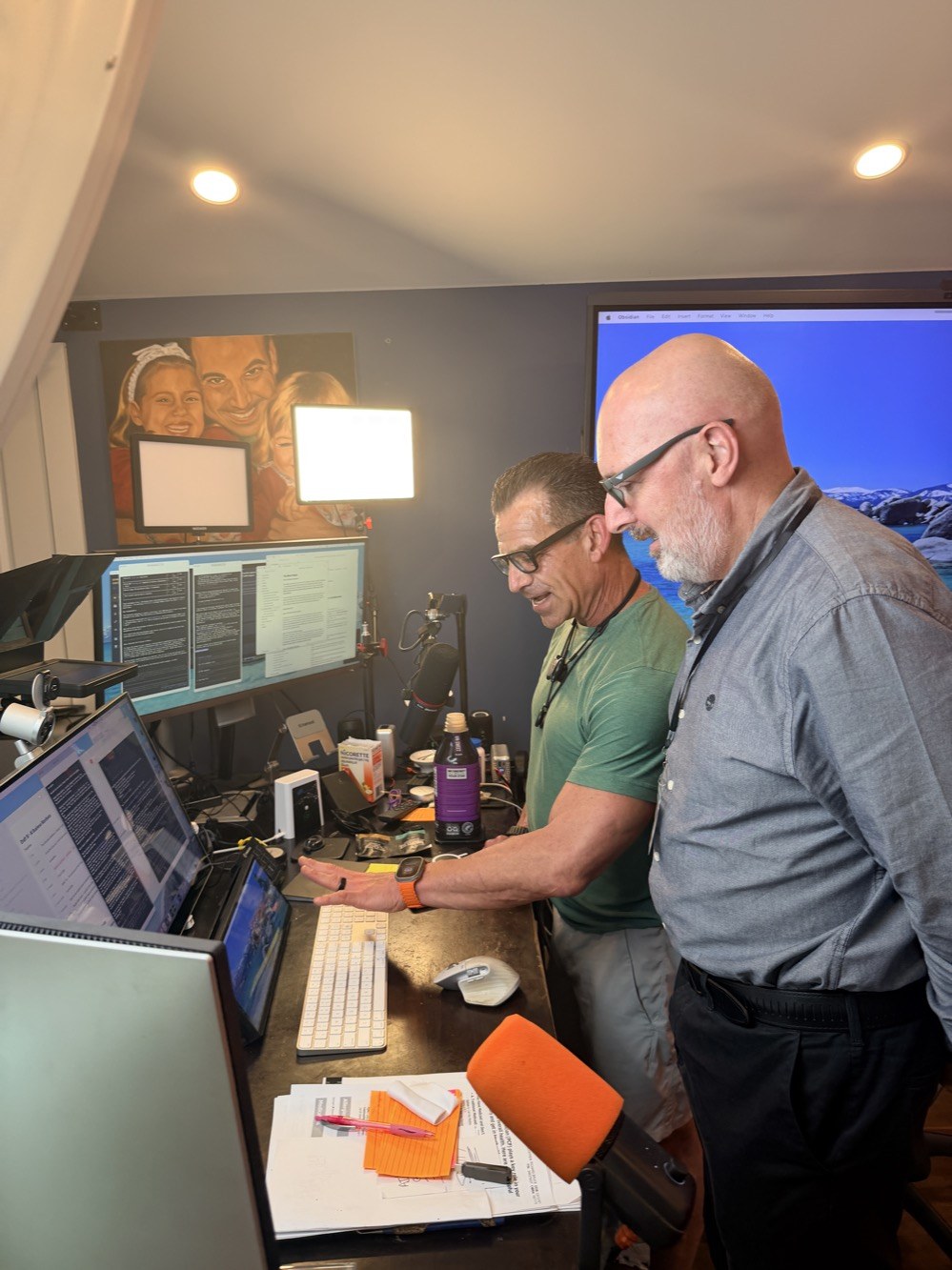
Your Blue Island AI is the work of Koen de Wit. For close to a decade, under his practice The Funnel Therapist, he has helped coaches, consultants, speakers, and creators with their marketing and their funnels.
The reason a person sits here and not a signup form is the whole argument of this page. The Dig and The Refusal Map cannot be performed by software. Excavating how you decide is the un-commoditizable work no signup can do on your behalf.
He is mentored by Rich Schefren, the strategist the biggest names in marketing quietly turn to. He is in Rich's Zenith Pro, and has sat with him privately at his home in Delray Beach.
The principle this method draws from is Rich's: the most valuable part of an expert's thinking is the part that never makes it onto the page. That is exactly what this method exists to recover.
Creators with YouTube audiences approaching a million and beyond: Dr. Orion Taraban (PsycHacks), Brian Scott (The Reality Revolution), and Olympic medalist Tony Jeffries (Boxing Fitness Academy).
Coaches and authors with real bodies of work: Jessica Cunningham (Belief Coding) and Cicely Simpson, award-winning author of "Pull Up Your Chair."
Experts he has built funnels for: Jeremy Miner (7th Level), Natasha Takahashi, Bruce Guan, and Ben Robinson.
And the rooms behind them: consultants who are approved providers to Meta, Google, and Amazon. He also consults for ClickFunnels in their funnel-builder coaching and certification program.
The size of the following was never the point. What these people share is expertise worth excavating, and that is the only thing that matters here, whether you are known to millions or to the few hundred clients who pay you precisely because of how you think. The judgment in every one of these engagements belonged to the expert. The work was to recover it and hand it back. That is the work here.
A custom AI system, built from how you decide, that lives on your own machine. Ask it something in your field and it reasons to your answer the way you would, declining what it can't answer instead of guessing. You can spin agents off it, an email writer, a research assistant, each carrying your judgment. You don't log into it. You own it.
Those are built from what you produced, your words and your output. They reflect the surface and miss the reasoning underneath, so they forget, invent, and flatten. This is built from how you decide, including what you refuse, dug out by a person from your real decisions. A signup can't reach that. It's why this doesn't come back hollow.
Four moves: we dig out how you decide, case by case; we map what you refuse; we encode it into the system; you own the result on your machine. You start with one real decision, so you watch it work on your own material before committing to the full build. Your job is to think out loud. The building is ours.
You don't take it on faith. The first step reproduces your judgment on one of your own real decisions, in front of you, including a refusal you would make. You certify it's you before the full build goes ahead. If it doesn't pass, it doesn't proceed. You hold the verdict.
That half is the whole point. The bottleneck was never that your judgment can't be encoded. It's that no one ever excavated it. We don't ask you to write it down. We work through your real decisions and surface the rules you apply without naming them, the way they were learned in the first place: on cases, not from a manual.
The opposite. Keeping your judgment locked in one head is what caps it, and retires it with you. The experts whose names became methods didn't hoard theirs; they built something that ran without them and stayed at the head of it. You don't become replaceable. You become the source it all traces back to, and the authority over everything it produces.
You own the vault, on your own infrastructure, and you control what goes into the system. It is not a public tool that keeps everything you type and trains on it; it runs under your control on terms that do not train on your data. For a regulated firm that is the point: an owned, controlled system clears the confidentiality bar that rules public tools out before price even comes up.
You own it outright. It doesn't vanish if you stop paying, and there's nothing to claw back from a vendor because it was yours from day one. It compounds every time you add a case.
You start with one bounded engagement on a single decision, not a months-long project before you see anything work. The full build scales with how much of your domain you want encoded, and we scope that up front. Your time is mostly the excavation sessions, thinking through real decisions. The rest is ours.
There's no package menu, because your practice isn't a tier. The build is priced from what it actually needs, which is a conversation, not a checkout. What's fixed is where you start: the Excavation, a defined, paid first step, and that fee credits toward the build.
No. You bring the judgment; we handle the build and the setup on your infrastructure. You use it like any tool that answers questions, except the answers are yours.
Fair question. For close to a decade I've fixed marketing and funnels for coaches, consultants, and creators as The Funnel Therapist, and Russell Brunson named me a top funnel builder in 2024 and 2025. I'm mentored by Rich Schefren, the business strategist that names like Ryan Deiss, Jay Abraham, Frank Kern, and Todd Brown go to for advice. But the real answer is simpler: I built this on myself first. The demo above is my own judgment, running. I won't sell you something I haven't already done to my own work.
It starts with a short call. Thirty minutes on your work, what you have already tried, and whether this is worth building for you. No pitch, no obligation.
If it is a fit, you begin with one real decision of yours. The system makes the call the way you would, and declines the one your method forbids. You are not asked to take anything on faith. You watch it happen on your own material.
Then you edit what it produces. That edit is the proof: the judgment is yours, the authority is yours, and it stays that way.
The build that follows is bespoke, priced from what your practice actually needs, with no menu, and that first step credits toward it. What you own at the end does not expire, does not rent itself back to you, and holds your line in the rooms you are not in.
How you decide took decades to build. Whether it stays locked in one head is now a thirty-minute conversation.
A 30-minute call, no obligation.